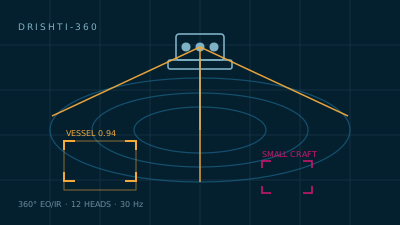
A twelve-head masthead ring that stitches low-light colour and uncooled thermal imagery into one continuous horizon, then detects, classifies and tracks every surface contact in it — including the small wooden craft that never appear on AIS or radar.
The problem
What this exists to solve.
A bridge watch on a warship or a bulk carrier is asked to hold a continuous visual lookout under COLREG Rule 5 — in glare, in haze, at night, through a night-vision device, for four hours at a stretch. Radar loses small wooden fishing craft in sea clutter. AIS never had them to begin with: carriage rules only bind cargo ships over 300 GT and passenger ships, so the most collision-prone traffic in Indian coastal waters is precisely the traffic that is electronically invisible.
Our approach
How DRISHTI-360 handles it.
DRISHTI-360 treats the horizon as a single continuous image rather than a set of camera feeds. Twelve heads — six low-light colour, six uncooled LWIR — are factory-calibrated as a rigid rig, stitched into one cylindrical panorama and stabilised against pitch and roll using the ship's own attitude reference. Detection runs on the stitched panorama, so a contact crossing a seam is one track, not two.
Capability
What it does well.
Seam-free tracking
Detection runs on the stitched cylinder, so a contact never fragments into two tracks as it crosses a camera boundary.
Dark-vessel emphasis
Models are weighted toward the non-AIS traffic that dominates Indian coastal waters — country craft, gillnetters, dhows and unlit skiffs.
Glare and monsoon hardening
Trained on Arabian Sea and Bay of Bengal footage across sea states 0–6, including south-west monsoon rain and post-monsoon haze.
Range and bearing at the alert
Every track carries a horizon-geometry range estimate and true bearing, ready to hand to ARPA or the autopilot.
Recorded evidence
Rolling encrypted buffer with track overlay, exportable for incident review or class investigation.
Specification
Technical data.
Figures are typical values at nominal conditions. Acceptance criteria are agreed per programme and verified at trials — we do not quote a number we will not demonstrate.
| Coverage | 360° azimuth, −15° to +25° elevation, no blind seam |
|---|---|
| Sensor heads | 6 × low-light CMOS (0.0001 lux colour) + 6 × uncooled LWIR 640×512 |
| Optical resolution | Combined 48 MP panorama at 30 Hz; 0.42 mrad IFOV |
| Detection range | Vessel >20 m: 12 NM · small craft <7 m: 3.5 NM · person in water: 900 m |
| Classification | 14 marine classes incl. fishing craft, RHIB, dhow, buoy, floating debris, swimmer |
| Fusion inputs | ARPA/radar target stream, AIS (Class A/B), GNSS, gyro, ECDIS chart layer |
| Latency | <120 ms sensor-to-alert on SETU-EDGE E60 |
| Interfaces | NMEA 0183/2000, IEC 61162-450, RTSP, ONVIF-S, gRPC, REST |
| Power | 24 V DC nominal (18–32 V), 145 W typical, 210 W with de-icing |
| Environment | IP67, salt-fog EN 60945 Exposed, −25 °C to +60 °C, 5 g vibration |
| Mass | Ring assembly 14.2 kg · mast adapter 3.1 kg |
| Cabling | Single armoured Cat6A + power to below-deck node, up to 90 m |
Start a conversation
Evaluate DRISHTI-360 on your platform.
We run structured evaluations: a defined operating profile, an agreed acceptance criterion, and a trials report you can take to your own review board.