Bengaluru · Marine perception, built in India
Machine sight for the Indian Ocean.
SagarAI builds the cameras, the edge compute and the perception models that let warships, uncrewed craft, shipyards and merchant fleets see for themselves — trained on the water they actually operate in, supported by engineers in the same time zone.
Aligned with
Figures reflect publicly stated Government of India maritime and naval planning targets. See Make in India for sources and our indigenisation position.
The problem we exist for
The most dangerous traffic in Indian waters is the traffic no sensor reports.
Carriage rules only oblige cargo ships above 300 gross tonnes and passenger ships to transmit AIS. Everything smaller — the country craft, gillnetters and unlit skiffs that fill Indian coastal waters — is electronically silent by default. Radar loses them in sea clutter because they are low, small and often wooden.
Which leaves sight. A trained lookout resolves what radar and AIS cannot, and does it in a fraction of a second. What a lookout cannot do is hold that attention across a four-hour middle watch, in glare, in monsoon rain, on the eleventh consecutive day at sea. That gap is the whole of our engineering.
See it work
Nine tasks you can try, not just read about.
Super-resolution, denoising, detection, segmentation, dark-vessel fusion, route planning, seabed mineral survey, rare species identification. Each one is a working demonstration that runs in your browser — drag the slider, move the threshold, tap the chart and watch the route re-plan.
It takes about four minutes and it will tell you more than this page can.
Product range
Seven products, one perception stack.
Every product shares the same detection, tracking and fusion core, so a hull, a yard and a shore station produce the same track identities and feed the same operational picture.
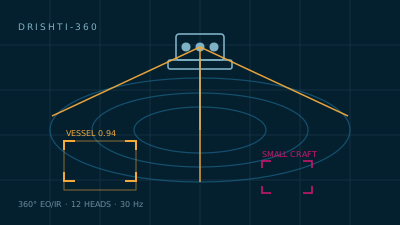
DRISHTI-360
360° EO/IR panoramic situational awareness mast
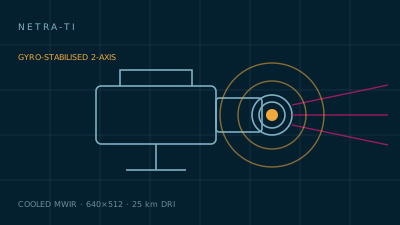
NETRA-TI
Gyro-stabilised long-range thermal sight
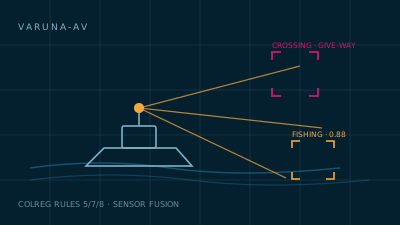
VARUNA-AV
COLREG-aware autonomous lookout stack for uncrewed vessels
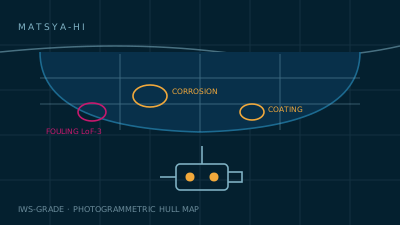
MATSYA-HI
Underwater hull inspection vision payload
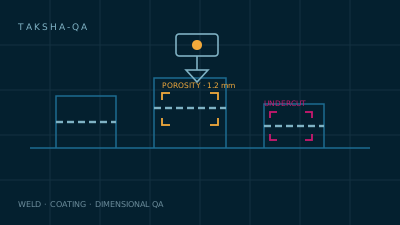
TAKSHA-QA
Shipyard weld, coating and dimensional quality inspection
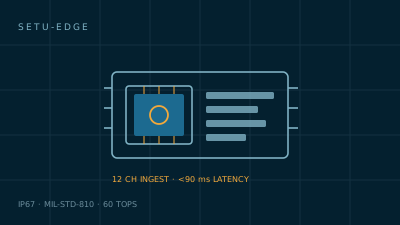
SETU-EDGE
Rugged marine edge-AI compute node
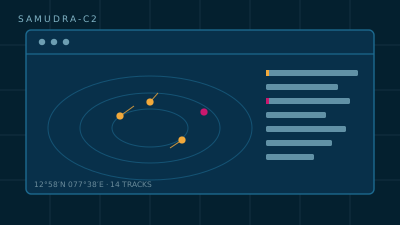
SAMUDRA-C2
Fleet and shore command vision platform
Where it goes to work
Six operating environments.
Naval, yard, port, fleet, coastal and geospatial. Different acceptance criteria, different procurement routes, the same underlying stack.
Naval & defence
Watchkeeping, force protection and maritime domain awareness
Shipyard production
Weld quality, block metrology and yard safety
Ports & harbour security
Berth monitoring, intrusion detection and VTS support
Commercial fleets
Bridge assistance, hull condition and fuel-side return
Coastal surveillance
Dark-vessel detection and EEZ protection
Geospatial & hydrography
Shoreline change and chart-grade feature extraction
Working with
Organisations building India's maritime capability.
Defence public sector undertakings, the yards constructing the Navy's order book, India's largest private shipping company, and the country's own mapping platform.






Our position
Built here, because the water is different here.
An electro-optic system trained on the North Sea has never seen a monsoon squall line, a fleet of unlit country craft at dusk, or the particular haze that sits over the Bay of Bengal after the rains. Perception models inherit the distribution they were trained on. Ours inherits this one.
Beyond the technical case, there is a supply case. Sub-systems on the defence indigenisation lists cannot be imported indefinitely, spares from abroad arrive on someone else's schedule, and a model you cannot retrain is a model you cannot fix. We design, train and support in India — and we say plainly which parts of the bill of materials are not yet domestic, and what we are doing about them.






Insights
Field notes.
Why marine vision has to be built in India, not bought
Imported electro-optic systems are trained on the wrong water. The argument for indigenous marine perception is technical before it is political.
What COLREGs actually demand of an autonomous lookout
Rule 5 says 'by sight and hearing'. Rule 7 says 'if there is any doubt'. Building a machine that satisfies both is harder — and more interesting — than avoiding radar returns.
The hull survey that pays for itself before the ship reaches the yard
The value of AI hull inspection is not the footage. It is arriving at the drydock planning meeting with measurements instead of impressions.
Start a conversation
Bring machine sight to your hull, yard or fleet.
Send us your operating profile and we will come back with a sensor plan, an integration route and a trials schedule — usually within two working days.